Wednesday, September 30, 2009

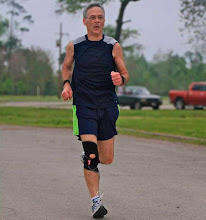
September Running Milestones

Most miles in a month: 120.7
Most miles in a week: 29.8, week ending September 20.
Longest run to date: 14.2 miles, September 19.

Monday, September 28, 2009

Weekly Training, September 21-27

Sunday: Recovery run; Nice and easy; 3.2 miles; 37:49; 11.81 pace. 7:45 AM, 76 degrees, 96% humidity. Resting HR: 49 bpm; Workout HR: 143 bpm.

Saturday: 14.2 miles. Started @6:45 AM, 71 degrees, 98% humidity. No new record attempt today, just aiming to hold last week's gains by doing last Saturday's new distance a second time. For a little change up, I experimented with Jeff Galloway's Run-Walk approach to long run training. For this experiment, I walked 1 to 2 minutes for every 8 to 10 minutes of running. The idea is that the walk breaks push the fatigue factor further back, allowing for a stronger finish. Today, this approach resulted in a longer total time than last Saturday's 14 miler; 2:49:22, 11.93 pace. However, it seemed like each level of fatigue came about two miles later than the previous run. Last week, I struggled to complete the distance, and this week I felt like I could have gone a couple additional miles. I also think I could reduce the walk times and get the same benefit. Galloway says that the early-mile breaks are more important than later-mile breaks.
Here's a link to an article by Jeff Galloway.

Monday through Friday: Alternating Easy runs and Tempo Runs. As I've read more, I decided to try substituting Tempo Runs for the sprint intervals. The sprint pace came with enough extra shock to aggravate my heel pain. Like most runners, I'll experiment with a lot of methods and settle on what works best for me. Unfortunately, I've mostly learned "what not to do" the hard way; by trying things and quitting whatever hurts. Anyway, the Tempo seems like a good middle ground, harder than long-run and easy-run pace, but not not nearly as intense as all-out sprints. In theory, Tempo sounds good for long-distance training. Seems like there is a lot of confusion out there about what a Tempo Run is. I had to search a little bit to find articles that defined it well.  It's just a run of at least 20 minutes at threshold pace.  The idea is to train just below Lactate Threshold (or Anaerobic Threshold), or at 85 - 90% of max heart rate, which results in pushing the LT/AT farther back.  The training should boost speed, and also help delay onset of "the wall" on longer runs. Pace is easy to determine by using a heart rate monitor.  To determine pace based on time, The McMillan Running Calculator  is a good tool.  The calculator estimates running time for various race distances based on a good, recent race time at another distance.  It also gives pace ranges for different types of workout runs, including Tempo Runs.
Here's a link to a good article on Tempo Runs. 
Here's a link to another Tempo Run article.

Monday: Tempo Run; 3.1 miles; 28:16; 9.12 pace.
Tuesday: Easy Run; 3.1 miles; 30:44; 9.91 pace.
Wednesday: Tempo Run; 3.1 miles; 28:12; 9.10 pace.
Thursday: Easy Run; 3.1 miles; 31:08; 10.03 pace.
Friday: Rest Day.

Sunday, September 27, 2009

The Bottled Water Scam


The sale of bottled water is a case of brilliant marketing—to convince the public to buy filtered bottled water—at a price per gallon that is higher than gasoline! The cost is great to the environment and to the consumer. 

Most plastic bottles do not get recycled.  Even if the bottles are recycled, they are the product of an energy consuming supply chain.  Bottling plants consume a lot of energy.  In addition, consider the diesel fuel consumed, and the resulting air pollution, from transporting thousands of truckloads of bottled water all over the country every day.

And the cost to the consumer—if a 16 oz. bottle of water costs $1, that’s $8 a gallon, twice as much as gasoline at its summer 2008 peak! What a scam!  It is ironic that we pay this price for water in a nation that has the cleanest and most widely available public water systems in the world.

A few statistics:

  • 70 million bottles of water are consumed in the U.S. each day.
  • Americans threw more than 22 billion water bottles in the trash in 2006.
  • Eight out of 10 plastic water bottles become landfill waste.
  • Plastic bottles take 700 years before they begin to decompose in a landfill.
  • It takes over 1.5 million barrels of oil to manufacture a year’s supply of bottled water. Apply the principle of supply and demand and consider the effect of the demand for a needless 1.5 million barrels of oil on the price of our gasoline! 
Most bottled water is just filtered municipal tap water.  We can save hundreds of dollars per year (and help the environment) by buying any one of several types of filtering pitchers or systems, filtering our own tap water, and filling our own reusable water bottles. The result is water that is just as clean and good-tasting as commercially filtered water.

As a runner, in addition to water, I use sports drinks for electrolyte replacement and for energy.  I've found that a good substitute for a bottled sports drink is a powdered sports drink and a reuseable aluminum bottle.  For a 32 ounce sports drink, consider how much fuel it takes to ship a few grams of powder, versus the fuel it takes to ship the same ingredients added to 2 pounds of water!  Sugar-free powdered electrolyte mixes come in a lot of flavors, and come in very small packets that fit easily in a pocket.   I like these when I just need hydration.  When my bottle is empty, I refill at a water fountain, and add the powder.  For long endurance runs, I may want a carb boost in addition to the electrolytes, so I carry the sugar-sweetened Gatorade mix in pre-measured portions in small containers.  I find that small prescription bottles make good containers for powder.

Run Green!

Sunday, September 20, 2009

September 20, 2009 - Recovery Run

Recently, I’ve been taking Sunday off after my Saturday long run. However, today I decided to try following the long run with a “recovery run.” I didn’t think about starting this technique until recently; I just started really pushing the long run distance last month. When I first started increasing distance, I followed the long run with a normal medium distance hard run on the next day. That turned out to be a mistake. Then, for several weeks, I took the day following the long run off completely. That worked out better. However, recently I’ve been reading more about the benefits of the recovery run. Here's a link to a good recovery run article. 
To summarize, this article discusses the widely-held assumption that recovery runs, relatively short, slow runs within 24 hours after a harder run, clear lactic acid from the legs and facilitate recovery from preceding hard training. In this article the author maintains that lactic acid levels return to normal within an hour after a workout; that recovery runs do not actually enhance recovery. He sees the real benefit of recovery runs coming from working out again in a state of lingering fatigue from the previous training. Long runs boost fitness by taking the body well beyond the point of initial fatigue; recovery runs are performed entirely in a fatigued state, so they boost fitness despite being shorter and/or slower than key workouts.

So, I took a 3.2 miler, very slow and easy, 44:37, had to consciously hold back to keep it really comfortable and stayed under 125 bpm. It felt good- a light workout while still a little achy warmed everything up and seemed to help the aches, without being hard enough to cause any additional fatigue or foot pain.

Saturday, September 19, 2009

September 19, 2009 - New Distance Milestone!

Today’s goal-- stretch the long run a little farther, to 14.2 miles: 1 mile between the house and the trail in the park, out-and-back, plus 6 laps in the park, 2.2 miles each.
Laps 1 and 2: Nice, comfortable running, in the groove, feeling good, endorphins flowing like water. The sun is just now rising, and it’s a beautiful morning in the park. It’s 72 degrees, and feels soooo much better than the 78 to 82 degree morning lows that we’ve had since June.
Lap 3: Concentrating on mechanics. Smooth stride, staying relaxed. Feeling like I can go like this all day. I’m a running machine. I own the trail. The trail is mine.
Lap 4: A little fatigue was setting in around the end of mile 7; a little second wind building in mile 8.
Lap 5: Struggling a little more going into mile 10; my HRM is reading 160 bpm. I don’t need to push too long beyond 95% of max HR. I had thoughts about cutting this one off after 5 laps, and slowed down to a walk. After about 2 minutes, HR was down to 128, and I continued the run at a little slower pace.
Lap 6: The slower pace feels OK, 145 - 150 bpm, and what's one more lap at this point? Just concentrate on putting one foot in front of the other, and this approach gets me home, 14.2 miles, 2:39:05, 11.2 min/mi. Another new distance PR. My feet were a little sore, and I soaked them in a bucket of ice water...OH YEAH. Afterwards, after soaking, stretching and showering, I felt pretty good.

Friday, September 18, 2009

Weekday Workouts, September 14-18

3.1 mile runs Monday through Thursday morning, plus an extra 3.2 miles on the bicycle Tuesday afternoon, to double-check my weekend lap distance with the GPS. No run on Friday morning, just a light cross-training day (6.2 miles, bicycle) to be fresh for the Saturday long run.

Sunday, September 13, 2009

Weekly Training, September 7-13

Sunday - Day off; Rest and recovery.

Saturday - I backed off to 11.5 miles; my left heel still a little sore after this week's sprints, no need to push another distance record yet. I tried a little different variation and skipped the carb loading for the long run. I'd been loading up to provide extra energy for the increasingly longer runs, to prevent running out of gas before making the distance I wanted. However, I read about a training program that recommended skipping the carb load on some of the long runs. The theory is that by intentionally letting the glycogen reserves become depleted, it trains the body to switch over to drawing on stored fats for energy when needed. And then by loading carbs after the run, in a more depleted state, the muscles would adapt to store more glycogen than before. Just have to be prepared to "hit the wall" and push through it during the transition. Sure enough, heavy fatigue set in after about an hour and a half, and the rest of the way was a struggle, taking 7 more minutes than the same distance two weeks before. I don't think I'll continue to carb-deprive myself. Maybe something to try later, after I've worked up to marathon distance.

Friday - I planned to take a rest day Friday before my Saturday long run. However, after skipping Thursday, I ran another 5K Friday instead (feet still a little sore, resulting in a slow run - 30:41).

Thursday - Unplanned rest day due to early morning thuderstorm.

Wednesday - 8 x 400 meter sprints, resulting in sore feet. I'm going to back off of the fast runs; they give a harder pounding to the feet. The most important thing at this point is continuing the long runs.

Tuesday - Nice 5K, felt good, decent time, 27:47, 8.96 pace.

Monday, September 7, Labor Day - I felt good after resting Sunday, and tried a new trail, the Goose Creek Stream Greenbelt Hike and Bike Trail. It starts out by the Bayland Park marina near where Goose Creek meets Tabbs Bay, off of Galveston Bay. The trail follows Goose Creek upstream and links two other Baytown city parks, turning around, and returning along the same route. It's a 2.44 mile trail, out-and-back, for a 4.88 mile total. The trail also has a couple of nice uphill stretches that I don't get on my routine routes. I didn't feel like I was pushing the pace, but made it in 42:28.29; 8.7 minutes/mile, only 0.07 off my best 5K pace.
Here's a link to trail details.

Sunday, September 6, 2009

Weekly Training, September 1-5: Half-Way There!

Saturday - 13.7 miles, 2:32:16, 11.11 pace. Another new distance record! I had to push a little on the last lap, but not as difficult as I expected. A little sore in the legs afterward, but only a little heel pain. I bought some cushioned arch/heel support inserts for my shoes last week, and they helped a lot. I also iced my feet after the run, and that helped too. Last week's formula worked well, so I'll take my recovery day Sunday. My intermediate goal on the way to the marathon was to run a half-marathon race. Now that I've run the half-marathon distance fairly comfortably on a training run, I may not set a race as a priority, and just train for the marathon. The Houston Marathon has been filled up for months, but I recently learned that Beaumont, Texas will have its first ever marathon race May 1, 2010. I'm sure I can be ready by then.

Tuesday through Friday - Easy 3.1-mile daily runs. Better pace than last week; times in the 27s and 28s. Threw in one 8 x 400 meter wind sprint interval routine on Wednesday.

Tuesday, September 1, 2009

Green Running

Earlier this year, I came across an interesting collection of articles on "Green Running" at Runners World.  Here's a link to the articles. I really liked the article titled "How to Be a Greener Runner," "30 things even a busy, sane person (i.e., you) can do."  Here, the environmentally-conscious runner will find "Good," "Better," and "Best" suggestions in a number of categories.  I think that the important thing to recognize is that it may not be possible for every runner to use all of  the suggestions.  However, the power of collective action is for concerned individuals to be aware and to each just do what they can; the cumulative effect makes a big difference.  Here's what I'm doing:
  • I start most of my runs from my home. Of course, this may not work for runners living in busy urban areas.  I'm fortunate to have a park within running distance and fairly quiet neighborhood roads to run.  Of course, we all need a change of scenery occasionally.
  • I haven't run a lot of races, but when I race, I'll target local races as much as possible. Of course, if you don't live near Boston, and your life's ambition is to run the Boston Marathon, why not go for it?  We all have to make choices every day and make trade-offs based on what's important to us. 
  • I buy powdered sports drinks and mix them myself. I use a reuseable bottle for sports drinks or water.
  • I pick up litter along roadways and park trails where I run, and recycle the plastic, aluminum and glass. 
  • For cross-training, I bicycle from my home, use a stationary bike at home in bad weather, and work out with dumbells at home (instead of driving to a gym).
Run Green!

Blogger

I set up the Blogger account in September, 2009.  Selected pre-September postings have been migrated in from previous blog platform.

Monday, August 31, 2009

August Running Milestones

Most miles in a month: 116.4
Most miles in a week: 27.3, week ending August 16.
Longest run to date: 12.0 miles, August 29.

August Training

Monday, August 31 - Comfortable 3.1-miler; a little slow, 31:00, 10.0 pace. Probably still a little residual fatigue from the long Saturday run.

Sunday, August 30 - Took a recovery day, instead of trying to push too hard again on consecutive days. Looks like the formula that may work for me is to do the long run the day after an easy run, and then rest the next day. Soreness is nearly gone already.

Saturday, August 29 – A new distance record: 12 miles! The 5th lap was a bit of a push, but not as tough as the 4th lap was two weeks ago. 2:09:16 - only a minute longer than the 9.8 miler two weeks ago, 10.77 pace. Still no blisters; CoolMax socks rock! It was another steamy gulf-coast morning, but my weight was only down 1 1/2 lbs; seem to finally have the hydration thing figured out. I downed a 32 oz Gatorade an hour before running. And I carried a 20-oz aluminum bottle with me on the trail. I started out with a full bottle for the 1st lap, and carried 4 pre-measured baggies of powdered Gatorade in my pocket. Dumping a baggie and refilling at the water fountain on each 2-mile lap did the trick, kept me hydrated and gave me a 30 gram carb boost on each refill. Heel pain the rest of the day; still need to find some decent arch supports.

August 25, 26, 27, 28 - Good 3.1-mile weekday morning runs. Typical pace; around 9 1/2 minutes early in the week, following a day of rest, trending to 10+ on Friday. Easy steady-paced runs M-T-W-F. Thursday, 8 x 400 meter wind sprints with one- to three-minute slow jog or brisk walk recoveries in between. Same basic routine as August 14, only 2 x the sprints and less cool down at the end. Total 3.1 miles, 29:27, 9.5 pace.

Monday, August 24 - A much needed recovery day.

Sunday, August 23 - Another 7.6 miles, but just barely. Hoped to make another 9.8, but didn't have it in me. I must be crazy, trying to make two longer runs on consecutive days, but weekends are the only days I have the time to log the extra miles. I probably need to just go one long run and stretch the distance out on it. Last week, I did the longer of the two on Saturday, and struggled on Sunday. I thought maybe it would work better doing the shorter one on first, ramping up to the longer one. WRONG. Looking forward to a recovery day tomorrow.

Saturday, August 22 - 7.6 miles. Got a good early start to beat the heat, right about sunrise, and stayed well hydrated. No blisters-- ditched the cotton socks and picked up some CoolMax. I felt good; could have gone longer; but tried to hold a little back for a longer run on Sunday.

August 19 through 21- Routine. 3.1 miles each. 9.6 – 9.9 pace.

August 18 - Unplanned extra rest day; early morning thunderstorm & lots of lightning.

Monday, August 17 - Recovery day! No workout! Just stretches, lots of liquids. I was still sore in the morning, but almost pain-free by evening. The recuperative powers of the human body are amazing! Back up to normal weight by evening. Ready to rip up the roads again tomorrow morning!

Sunday, August 16 – Ran my typical weekend 6.2 miler through the parks. BAD IDEA, without a recovery day after the 9.8 on Saturday. Maybe I should have gone the shorter one on Saturday instead of Sunday. Really struggled to finish; cramps, sore legs, plantar fasciitis flaring up in left heel (Note to self: pick up those arch supports you’ve been looking at), and blister developing on right heel (Note to self: ditch the cotton socks and pick up some synthetics). My weight was down 6 pounds weighing in after run (Note to self: re-read hydration note to self from Saturday). I ran into Mike, a runner acquaintance, on the way out of the park. Mike’s an experienced marathoner; he’s run the Boston, New York, Houston, etc, etc. He’s just starting to gear up for the fall, has just been logging hours on these hot days, not worrying about miles or pace. He offered some words that I found encouraging; said that the hard training I’ve been doing in hot weather would pay off when it cools down; that at 50 degrees, I’ll be able to go either twice the distance or do the same distance in half the time. We’ll see.

Saturday August 15 - Time to try to push the envelope on the longer run. The farthest I’d ever run was about 8 miles, on January 24, 2009. I started to bonk at about 7 miles, and must have made the last mile on pure adrenaline. So anything over 8 would be icing on the cake. It’s a one-mile round trip from my home to the beginning of the dirt trail in Holloway Park, and each lap of the path I measured through Holloway and Jenkins Parks is 2.2 miles. If I could make 4 laps, it would give me 9.8 miles; 5 would make 12.0 miles. I hit the trail at 6:50 AM, managed to make the 4 laps, but didn’t have enough left for the 5th. (Note to self: 6 AM start would have been a little cooler). I thought I’d planned well enough for fuel and hydration, had 48 oz of carb/electrolyte drink before starting, and 48 oz more during the run, but I was down 4 ½ pounds when I weighed in after the 9.8 miles. (Note to self: double up on the liquids next time). Time was nothing to brag about: 2 hours 8 minutes, 13.0 pace, but the heat and humidity this time of year are so limiting, even in the early morning. My easiest runs are on weekdays when I go shorter distance in the dark at 5:30 AM, but even then, the humidity is oppressive. I drank lots of liquids all day and evening to rehydrate.

8/14/09 – If I’m going to get to the next level, It’s time to shake up my running routine; alternate some speed training, and work in some longer distance runs. For months, I’ve been running the same routine, 5K (3.1 miles) pre-dawn runs before work on weekday mornings, 10K (6.2 miles) on weekend mornings, and taking one recovery day on most weeks, usually bicycling or taking a brisk walk. Today, I tried to work on speed a little with a 4 x 400 meter interval routine:

1. About 200 meters– slow warm-up run.
2. 400 meter hard run #1.
3. Recovery #1-- 3 minutes brisk walk.
4. 400 meter hard run #2.
5. Recovery #2-- 2 minutes brisk walk.
6. 400 meter hard run #3.
7. Recovery #3 -- 1 minute brisk walk.
8. 400 meter hard run #4.
9. Half-mile cool-down run. 2 miles total.

Not too bad— with a shorter recovery each time, each successive speed run gets tougher. Two miles total, a little break from my normal three. Twenty minutes, same 10 minute/mile pace that my 5K runs have been (since the onset of the summer gulf-coast heat and humidity), even with 6 minutes of walking mixed in. Felt pretty good.

Wednesday, April 22, 2009

Happy Earth Day!


A perfect occasion to reaffirm commitment to this magnificent ecosphere on which we live!

Saturday, March 28, 2009

My First Race - MD Anderson Cancer Center SCOPE 5K


March 28, 2009 – My first race, the MD Anderson Cancer Center SCOPE 5K Run, around the Houston Medical Center area. I’d been training at 5K or better daily for a few months, so the distance wasn’t an issue. My fastest 5K training times had been between 30 – 31 minutes, so my goal was to “break 30, even if it’s 29:59, just as long as it starts with a 2,” and a make a respectable finish for my age and conditioning level. I had a little scare; after registering, I thought I might miss the race with a bad plantar fasciitis flare-up in my left heel. I couldn’t run at all for two weeks, just bicycled every morning to keep loose and maintain some level of conditioning. My fault—running every day, pain or not, with no breaks; thought the pain would go away if I kept pushing and worked through it. It didn’t. Also, looking back later at my mileage log, I saw that I went from 17.75 miles/week to 25.5 miles/week, 3 weeks before my foot made me stop running. That was a 43% mileage increase; at the time I hadn't even heard of the "10% rule" yet. The week of the race, it felt a lot better; I ran Tuesday and Wednesday, still felt good, and took Thursday and Friday off so I’d have fresh legs on race day. Saturday, morning, race day—a perfect morning to run hard and make a decent time. An unseasonably late cool front came through the night before; 40 degree temperature; 30 degree wind chill with gusty North wind. Cool enough that I had to break out a light set of long sweats I thought I’d retired for the season. I felt good—well rested, fresh legs, cool weather—fell into a comfortable pace on the first mile a little behind a man around my age who seemed to be running a little better than my routine pace. Coming up to the Mile 1 aid station, they were calling out times as people passed by. Two men, probably late-thirtyish, running a good pace, passed me on the left. As I passed the aid station, I heard “8:39” and thought, “Hey, I may have a shot at a pretty good time.” (I’d calculated that I’d need to average 9:40 minutes/mile to break 30.) I passed my first-mile pacer and fell in behind the thirtyish pair for the second mile. Coming up on the Mile 2 aid station, the thirtyish pair was fading a little. The station attendant called out “16:47.” I passed the thirtyish pair. Still felling good, I was able to pass 3 or 4 more people in the third mile. Rounding the last turn and seeing the finish line, I had enough left to sprint home. I finished at 26:41.1, 8.61 minutes/mile pace, 86th out of 285. I guess everything came together right; the cool weather, fresh, rested legs, and the adrenaline rush from the competition. Now I'm totally hooked!  Link To Results